
Most immediately, he pledged to move slowly if needed in winding down an oil window that provides dollars directly to state-run oil companies

In the year to date, 61 PSUs have lost an average of 22 per cent, with five companies losing more than half their share value. The BSE PSU index is down 10.6 per cent.

Countries with abundant resources are faring worse in terms of development than those with less.

He said trust and confidence were the backbone of any financial system and one should never underestimate the power of ethics and values.

Go for high quality and low-to-medium-duration funds in your debt portfolio

PSU divestment, LIC IPO, fiscal deficit: Budget 2021 marks a clear change in the Modi government's stance from fiscal conservatism to growth orientation.
The main reason was that CPI inflation would likely remain below 4 per cent till July.
Auto shares gain while banks, realty drop

Debt fund managers think the Reserve Bank governor might at best go for one rate cut in April.
RBI's steps will prevent rupee from slipping, even if OMCs meet entire $ demand from market

Investors are anxious over the US-China trade tension, a sharp devaluation in yuan and uncertainty over Kashmir issue.

Petronet LNG Ltd, India's largest liquefied natural gas importer, will raise $100 million through foreign currency convertible bonds in June-July, which would result in its promoters ONGC, GAIL IOC and BPCL shareholding falling by 7.5 per cent.

The finance ministry on Tuesday cited "green shoots" of recovery in agriculture, manufacturing and services sectors, and said the prompt policy measures taken by the government and RBI have helped reinvigorate the economy with minimal damage. Stating that the agricultural sector remains the foundation of the Indian economy, the ministry said that a normal monsoon, as has been forecast, should support the rebooting of economy.

Benchmark indices finished higher on hopes of economic reforms

Demonetisation impact, earnings growth, central bank policies will get attention.

Analysts attribute this outperformance to the government's proactive economic reform measures

Rating agency Crisil said corporates, especially those in the auto, aviation, consumer durables and oil sectors, will be "severely impacted" by rupee depreciation due to large overseas debt and limited hedging.

A lower opening of the domestic equity market put pressure on the rupee.

Given the concerns around trade wars that threaten to jeopardise global capital flows as well, attracting foreign capital needs to be a policy priority, says Neelkanth Mishra.

New Delhi should resist any temptation to act as spoiler and instead should cooperate with its SCO partners in reaching a regional consensus behind the formation of an interim government in Kabul, argues Ambassador M K Bhadrakumar.

The 50-share Nifty scaled a high of 10,207.90 intra-day but succumbed to profit-booking to finish at 10,184.15, up 53.50 points

The NSE Nifty too ended 58.60 points, or 0.54 per cent, higher at 10,967.30 after shuttling between 10,985.15 and 10,928 during the session.

Stretched valuations and slowdown in DII flows are some of the reasons why Goldman Sachs cut its India rating to 'market-weight'

The broader NSE Nifty too fell below the 10,100 level by dropping 100.10 points to end at 10,094.25
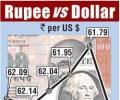
The partially convertible rupee closed at 62.16/17 per dollar compared to 61.79/80 on Tuesday. Financial markets were closed on Wednesday for Christmas.

We are much better placed than in 2013 with our overall fundamentals much stronger - higher foreign exchange reserves, a more favourable growth-inflation mix and an institutional framework for targeting inflation, says B Prasanna.

The immediate concern for the rupee is the sharp spike in oil prices

While global uncertainty has led to a rise in prices in 2016, there is still a lot of doubt regarding its future.

The broader Nifty too fell for the second straight session and closed with a loss of over 62 points, or 0.54 per cent, at 11,520.30, after hovering between 11,496.85 and 11,602.55.

Losers included Bharti Airtel, SBI, Wipro, Vedanta, Maruti Suzuki, ICICI Bank, Axis Bank and Reliance Industries, falling up to 2.18 per cent.

Experts caution against tough times in Indian equity markets in 2015.

The cash subsidy is a deviation from the earlier practice of issuing bonds for compensation. However, this is against the estimated underrecovery of about Rs 30,000 crore (Rs 300 billion) on cooking fuels made by the ministry of petroleum and natural gas for the current financial year.

The three companies in separate presentations to the Kirit Parikh Committee on fuel pricing suggested immediate freeing of petrol and diesel prices from government control.

The market last tumbled 10% or more in December 2016 following demonetisation. The decline was followed by a sharp rebound. This time the chances of such a v-shaped recovery are less.

Investors have turned cautious ahead of the policy meetings of central banks in Japan and the US

Finance Minister Pranab Mukherjee may have earned plaudits for projecting a decline in the fiscal deficit to 5.5 per cent of gross domestic product (GDP) for 2010-11, but his targets for revenue deficit reduction are relatively modest and represent a departure from the 13th Finance Commission's recommendations.

The negative aspect about the Budget is that the capital expenditure has been marginally cut to achieve the fiscal deficit target assumptions, and the onus of sustaining investment demand till private capex revives continues to vest with the public sector enterprises, notes Jyotivardhan Jaipuria.

The fact that the US recovery needs an elaborate defence suggests that things are far from certain.
 © 2026 Rediff.com - Advertise with us - Disclaimer - Privacy Policy - Sitemap - Feedback - About us - Terms of use - Grievances